What the Numbers on Your Tire's Sidewall Are Actually Trying to Tell You
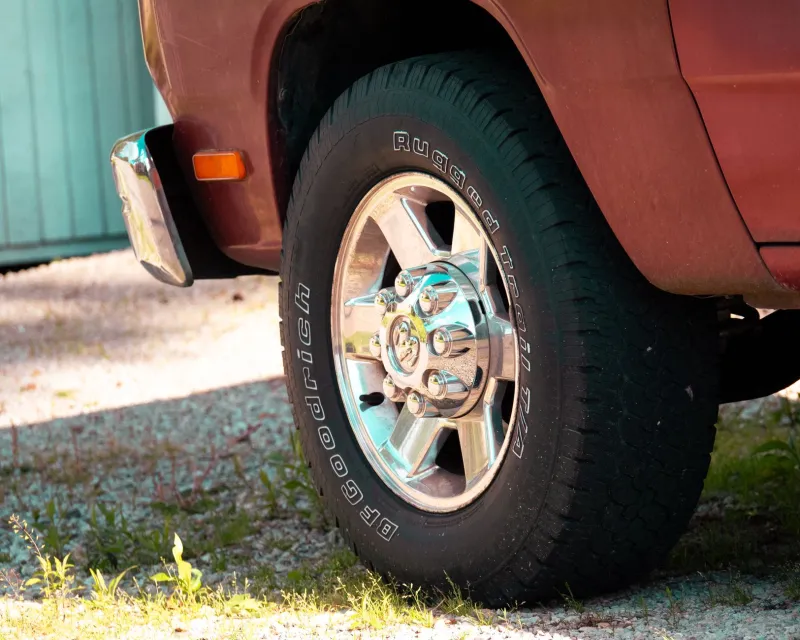
You've probably stared at the sidewall of your truck tire at some point and thought, what in the world does any of this mean? Something like LT265/70R17 121/118S stares back at you like a classified government code. And for most drivers, that's where the curiosity ends.
But here's the thing—every character in that sequence is doing real work. Those markings tell you how much weight your tires can safely carry, how fast you can push them, what kind of terrain they're built for, and whether they're actually appropriate for your truck. Ignoring them isn't just leaving money on the table; it can compromise your safety, tank your fuel economy, and in some cases, void your warranty.
Let's break it down in plain English.
LT vs. P: The First Letters Matter More Than You Think
Before you even get to the numbers, pay attention to the prefix. Tires marked with P (like P265/70R17) are passenger vehicle tires. They're designed for cars, minivans, and light-duty SUVs. Tires marked LT are light truck tires, built to handle heavier loads, higher inflation pressures, and tougher operating conditions.
If your truck is regularly hauling a payload, towing a trailer, or working on job sites, LT-rated tires aren't optional—they're the floor. Running P-metric tires on a truck that's pulling weight is like using a kitchen knife to cut lumber. It might work for a minute, but you're setting yourself up for a bad day.
Some tires skip the prefix entirely. Those are typically euro-metric tires, and they fall somewhere in between. Worth noting, but less common on American work trucks.
The Three-Part Size Code
Take 265/70R17 as an example:
- 265 — This is the tire's section width in millimeters. Think of it as how wide the tire is from sidewall to sidewall when properly mounted and inflated.
- 70 — This is the aspect ratio, meaning the sidewall height is 70% of the section width. A lower number here means a shorter, stiffer sidewall—common on performance tires. A higher number means more sidewall flex, which can help with rough terrain.
- R — This stands for radial construction, which is the standard for virtually every modern passenger and light truck tire sold in the US.
- 17 — The wheel diameter in inches. This one's straightforward.
For truck owners, the aspect ratio is worth paying attention to. If you're running off-road or dealing with uneven terrain, a higher sidewall can absorb punishment better. If you're mostly highway driving with a loaded trailer, a lower-profile tire on a larger wheel can improve handling and reduce sway.
Load Index: The Number That Could Save Your Truck (and Your Life)
This is arguably the most important number on the sidewall, and it's the one most people completely ignore. In the example 121/118S, the 121 and 118 are load index numbers.
Load index is a standardized code that corresponds to the maximum weight a tire can safely carry when properly inflated. A load index of 121 translates to roughly 3,197 pounds per tire. The two numbers separated by a slash indicate dual-rear-wheel applications—the first is for single mounting, the second is for dual mounting.
Here's where it gets important: your truck has a Gross Vehicle Weight Rating (GVWR) set by the manufacturer. Your tires need to collectively support that weight. If you're loading up a pickup with a full payload and towing a trailer, and your tires' combined load capacity doesn't cover what you're asking of them, you're operating outside of safe limits. Tires will overheat, sidewalls can fail, and handling goes sideways—literally.
Always check your truck's door jamb sticker or owner's manual for the recommended load index before buying tires. Don't just go by what was on the truck when you bought it, especially if you've modified your setup or changed how you use the vehicle.
Speed Rating: It's Not Just About Going Fast
The letter at the end of the size/load code is the speed rating. In our example, that's S, which corresponds to a maximum speed of 112 mph.
Common speed ratings you'll see on truck tires:
- Q — 99 mph (often on winter or off-road tires)
- R — 106 mph
- S — 112 mph
- T — 118 mph
- H — 130 mph
Now, before you think, I never drive 112 mph, so who cares—the speed rating isn't just about top speed. It's also a reflection of the tire's heat resistance and structural integrity under sustained load. A higher-rated tire is generally built with compounds and construction methods that handle stress better over time. For trucks that spend hours on the interstate fully loaded, a higher speed rating can mean better durability even at legal highway speeds.
That said, don't go chasing an H-rated tire for a work truck that'll spend its life at 65 mph with a flatbed. You'll pay more without getting a real-world benefit. Match the rating to your actual use case.
UTQG Ratings and Why Truck Owners Should Care
Down toward the bottom of the sidewall, you'll usually find three numbers grouped together—something like 500 A A. That's the Uniform Tire Quality Grading system, and it covers treadwear, traction, and temperature resistance.
- Treadwear — A relative index. 500 means the tire should last about 5x longer than the government's baseline test tire. Higher is generally better for long-haul highway use.
- Traction — Graded AA, A, B, or C. This measures wet-road stopping performance. AA is the best. For trucks that haul heavy loads, better traction grades mean shorter stopping distances when it matters most.
- Temperature — Graded A, B, or C. This measures heat resistance at sustained speeds. A-rated tires run cooler, which matters on long drives with a loaded truck.
DOT Code: Knowing When Your Tires Were Born
On one sidewall (not necessarily both), you'll find a DOT code. The last four digits tell you the week and year of manufacture. For example, 3521 means the tire was made in the 35th week of 2021.
This matters when you're buying used tires or even new-old-stock. Rubber degrades over time regardless of tread depth. Most manufacturers recommend replacing tires after six years, regardless of how they look. If you're buying tires and the DOT code shows they've been sitting in a warehouse for four years, factor that into your decision.
Don't Overshoot—or Undershoot
One of the most common mistakes truck owners make is buying tires based on looks or price alone. Going too aggressive with load ratings you don't need costs you in ride quality and fuel economy. Going too light for your actual use case puts you at risk.
The sweet spot is matching your tire specs to your real-world application—what you haul, how far you drive, what surfaces you cover, and what your truck's manufacturer actually recommends. That sidewall code isn't a suggestion. It's the tire's resume. Learn to read it, and you'll make smarter buying decisions every time.
Your truck works hard. Make sure the rubber it rides on is built for the job.